
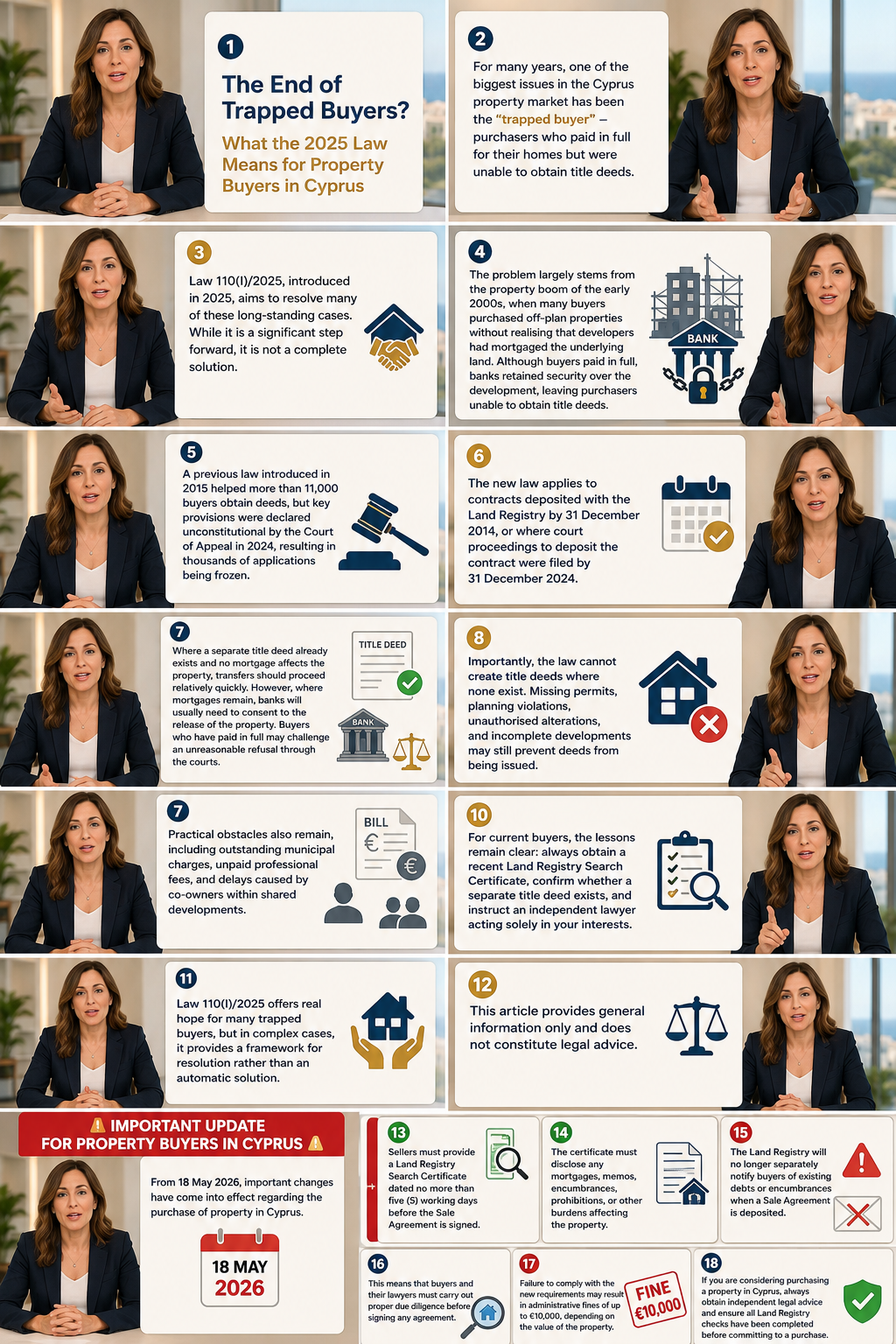
🚨 Important Update for Property Buyers in Cyprus 🚨
From 18 May 2026, important changes have come into effect regarding the purchase of property in Cyprus.
✅ Sellers must provide a Land Registry Search Certificate dated no more than five (5) working days before the Sale Agreement is signed.
✅ The certificate must disclose any mortgages, memos, encumbrances, prohibitions, or other burdens affecting the property.
⚠️ The Land Registry will no longer separately notify buyers of existing debts or encumbrances when a Sale Agreement is deposited.
This means that buyers and their lawyers must carry out proper due diligence before signing any agreement.
Failure to comply with the new requirements may result in administrative fines of up to €10,000, depending on the value of the property.
If you are considering purchasing a property in Cyprus, always obtain independent legal advice and ensure all Land Registry checks have been completed before committing to a purchase.
Trapped Buyers?
2025 Law – Property Buyers in Cyprus
For many years, one of the biggest issues in the Cyprus property market has been the “trapped buyer” – purchasers who paid in full for their homes but were unable to obtain title deeds.
Law 110(I)/2025, introduced in 2025, aims to resolve many of these long-standing cases. While it is a significant step forward, it is not a complete solution.
The problem largely stems from the property boom of the early 2000s, when many buyers purchased off-plan properties without realising that developers had mortgaged the underlying land. Although buyers paid in full, banks retained security over the development, leaving purchasers unable to obtain title deeds.
A previous law introduced in 2015 helped more than 11,000 buyers obtain deeds, but key provisions were declared unconstitutional by the Court of Appeal in 2024, resulting in thousands of applications being frozen.
The new law applies to contracts deposited with the Land Registry by 31 December 2014, or where court proceedings to deposit the contract were filed by 31 December 2024.
Where a separate title deed already exists and no mortgage affects the property, transfers should proceed relatively quickly. However, where mortgages remain, banks will usually need to consent to the release of the property. Buyers who have paid in full may challenge an unreasonable refusal through the courts.
Importantly, the law cannot create title deeds where none exist. Missing permits, planning violations, unauthorised alterations, and incomplete developments may still prevent deeds from being issued.
Practical obstacles also remain, including outstanding municipal charges, unpaid professional fees, and delays caused by co-owners within shared developments.
For current buyers, the lessons remain clear: always obtain a recent Land Registry Search Certificate, confirm whether a separate title deed exists, and instruct an independent lawyer acting solely in your interests.
Law 110(I)/2025 offers real hope for many trapped buyers, but in complex cases, it provides a framework for resolution rather than an automatic solution.